The Psalms: A Guide Through All of Life
Summer in the Psalms
Oh hey, short on time? No worries! I'd love to join you on your commute or daily walk/run, or shoot, even while you take care of that to-do list. We can't let these things get in the way of this friendship. It's just starting to get good! Click below to listen.
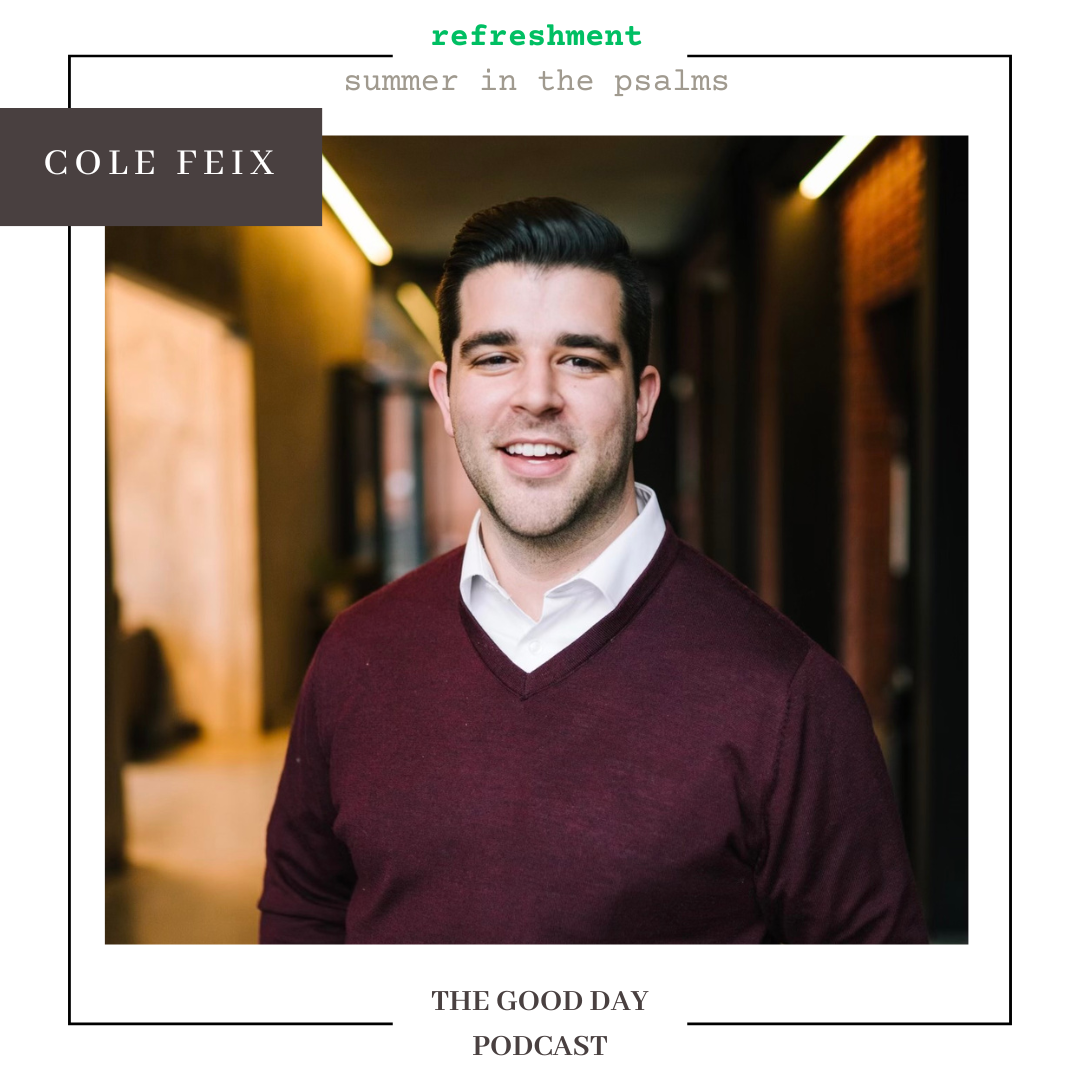
As we begin our Summer in the Psalms series this Summer, we're getting to hear from my friend, Cole Feix, as he helps us understand the Psalms as "the nervous system of the Bible."
Cole Feix is the Pastor of Carlton Landing Community Church in Oklahoma, the founder of So We Speak Media, and a director of the Library Co. He has a PhD from the Southern Baptist Theological Seminary and is an adjunct professor at Oklahoma Baptist University. He lives in southeast Oklahoma with his wife and three daughters.

Psalms is one of the most popular books of the Bible, but maybe for the wrong reason. I remember a time when my quiet times consisted of turning to my favorite psalms and feeling my way through the lines. It was easy, and it made me feel good; I felt like that was one part of the Bible that didn’t require any background knowledge or in-depth study. What I really wanted was to feel like I had met with God, and the Psalms were an easy place to pluck out a verse and think that’s what I was doing. I was in the right place, but I didn’t know what I was missing.
The Psalms are the nervous system of the Bible. They pervade the other 65 books and provide a sensory core for all of Scripture. All of the major biblical characters after Moses wrote, quoted, or worshipped to these holy hymns. The authors of the Psalms span almost a thousand years and comprise an unlikely cast of characters. The styles of the psalms are vibrant and creative. There are poems, acrostics, narratives, and songs.
Psalm 119 might be the most amazing. It’s divided into 22 sections, one for each letter of the Hebrew alphabet. In each section, all 8 lines begin with the letter of that section. The longest chapter of the Bible is also perfectly balanced. The verses are split evenly, 88 in the first half and 88 in the second, and at that same point, the words are evenly divided as well. There are 530 words in the first half and 530 in the second, with three words in the middle, translated in vs. 88 as,
that I may keep the testimonies of your mouth - Psalm 119:88
...the theme of the psalm. It is a literary masterpiece.
The Jews used the Psalms in every part of life. They would say 126 and 137 after meals, 90 and 91 at funerals, 84 at weddings, 120-134 on Sabbath afternoons, and 145 every night. Jesus and his disciples were intimately familiar with the Psalms. Matthew 26:30 says they sang a hymn together before they went to the Mount of Olives on the night Jesus was arrested. We know the songs they sang! After the Passover meal, the Jews sang the Hallel (where we get the word, Hallelujah), Psalms 113-118.
Paul considered the Psalms an essential part of the Christian life. In Ephesians 5:18, he describes the life of the believer:
Be filled with the Spirit, addressing one another in psalms and hymns and spiritual songs, singing and making melody to the Lord with your heart. - Ephesians 5:18
There’s a long tradition of taking this passage literally and singing the Psalms as hymns in the church; some churches still sing them exclusively in worship. The Reformers especially treasured the hymns. John Calvin commissioned a group of men to set every single psalm to music; he arranged more than a third of them himself.
Isaac Watts, one of the greatest hymn writers of the English language, read the psalms and wrote them in his own words during his quiet times. That’s how we got the most popular hymn of all time - Joy to the World, from Psalm 98.
Charles Spurgeon’s literary magnum opus, the Treasury of David, a seven-volume commentary, has never gone out of print. If he could have chosen only one of his books to continue his legacy, his wife said after his death, this would have been it.
In Christian monasteries for over a thousand years, monks have chanted through the entire Psalter every week. In the mornings, at meals, and during the watches of the night, the words of the Psalms echo in the ancient hallways.
As Christians, we have an invaluable treasure at our fingertips, but we need to know how to use it. Maybe more than any other book, the Psalms are an inexhaustible vault of riches that reward consistent use. Here are a few principles to enhance your time in the book of Psalms.
The Psalms are God’s words for every situation and every emotion.
We often overlook the fact that God has given us language for both our inner communication and outer communication. Our thoughts, passions, and emotions need to be discipled, and the Psalms give us pathways to do that. The Psalms tell us who we are and why we desperately need God. Calvin described them as “an anatomy of all parts of the soul.” They reveal the thoughts and intentions of our hearts and show us the ancient paths of worship.
This is why it’s important to allow the Psalms to chart their own course. Take Psalm 39 as an example. In vs. 1-3, David describes the trouble he has controlling his tongue. The more he tries, the more he fails. What does he do? In vs. 4-6, he centers himself by remembering that he is fleeting, just a blip on the radar in eternity. In vs. 7-11 he acknowledges the hand of the Lord in his struggle and thanks God for the painful discipline of fighting sin. Finally, in vs. 12-13, he cries out to God and asks for deliverance. This is an emotional template for us. Not every one of the psalms describes the right way to deal with our circumstances. It takes discernment to figure out which ones are good examples and which ones are warnings. This one is a good example. As we struggle with sin, we should walk along this same path.
Try following the pattern of the psalms. Pray them out loud or write them in your own words. Build spiritual muscle memory by walking through the thoughts and emotions of the authors.
The Psalms are essential in our worst moments.
I’ll never forget listening to CJ Mahaney say, “You will need your best theology in your worst moments.” There are 11 of David’s psalms that tell a story, and all of them describe a time of turmoil (3, 34, 51, 52, 54, 55, 56, 57, 59, 60, 63, 142). Part of the reason David was a man after God’s heart was that he constantly turned to God in every situation. When his life was at risk, he cried out to God to save him. When he was victorious over all of his enemies, he thanked God for his care and provision.
The Psalms are meant to be read as a whole.
This is true on an individual level and as an entire book. Although the Psalms were written over hundreds of years, they were first compiled and used for worship in David’s court and Solomon’s temple. Later, other songs were added, and editors arranged the book as we have it now. Each Psalm is a unit, and several of the Psalms we have now, like 42 and 43, have the same chorus. They may have originally been part of a single psalm. In addition, the book is grouped into five sections. Look at 41:13 to see the doxology at the end of book one and the beginning of book two. Scholars have analyzed the flow of the Psalms within each book. Try reading 3-5 psalms each day for a few weeks. The chapters play on each other, stretch out, and contrast. The psalms find their fullest expression as a cumulative whole.
The Psalms teach us how to run to God
So many times, our instinct is to run away from God. Whether it be our highest joy or the deepest pit, we are prone to wander from God, hide from him, or forget him altogether. The Psalms tether us to Christ, and they teach us to hide in him.Psalm 90 may be the oldest song in the group; Moses begins like this,
Lord, you have been our dwelling place in all generations. Before the mountains were brought forth, or ever you had formed the earth and the world, from everlasting to everlasting you are God. - Psalm 90:1-2
He recounts the history of God’s faithfulness to Israel. God knew we would need this perspective, so he preserved it as a reminder of his goodness throughout all generations.
The Psalms are God’s guide to worship
For most of church history, Psalms has been used as a biblical hymn book. You can’t go wrong singing the psalms. I don’t believe we’re required to only sing the psalms. But, while hymns and modern worship music are amazing tools for worshipping God, they’re not inspired; the psalms are. Learning to sing them stores them away for every situation.Here are some albums and playlists for singing the Psalms:
Poor Bishop Hooper - All the Psalms
The Psalms Project - Playlist of the first 30 Psalms
Robbie Seay Band - Psalms LP
Loud Harp - Asaph
My Soul Among Lions - Psalms 1-10 / 11-20
Here’s a Spotify playlist with all of these and a few more!
Wes Crawford’s Playmoss site has playlists for every single Psalm.
Make the Psalms a permanent part of your time in the word each day. Sing one in the morning or at night. See the change in your heart as you follow the pathways God has provided. Feel the joy of being filled with the Spirit as you overflow with songs, hymns, and spiritual songs.

Now, It's Your Turn!
Isn't it amazing God gave us words for every situation and emotion? I particularly love how Cole pointed out the Psalms are "pathways" to discipline our emotions.
May these Psalms not just be "a sensory core for Scripture," but as we come to these regularly in our study of God's Word, may these be the sensory core of our lives too.
And praise God for refreshment as we are intentional to spend a summer in the Psalms together, for if we want His truth to ever be on our lips, it must first be planted in our hearts.
Our strength grows as we rely on strength from above. Our joy grows as we see God transforming us from the inside out. Our peace grows as we spend time in God's presence, and we find rest when we intentionally seek the Lord first in our lives, for the Lord is ever our portion.
The good life, well it starts with a good day. Then another. Then another. Let's choose to live #TheGoodDay one day at a time.


Comments