Beyond the Noise: How to Hear God
Hearing God in a "Snowmageddon" World
What if seven words could change your day?
Okay, so it's not the seven words that hold the power, but they do help position our hearts to be still so we can receive this power. Since hearing a pastor of mine, Daniel Rankin, share these seven words from the Old Testament, I have been practicing starting my day this way, and I'll tell you, that's the easy part. Then actually being still and quiet (given I'm just waking up, that's not so hard) ...and listening.
It's hard at first, because it's not natural. I wake up and I'm ready to go. Even if I'm not energized to physically "go," my mind wants to "go" as soon as I tell it to be quiet and wait and be patient before the Lord. But, I know I need God's direction and guidance -- for my day and for the cares on my heart. I need His vision and His perspective. I need His correction. I need to know He is near and He cares. I need to know I'm not alone. I need my Shepherd's voice to lead me this day.
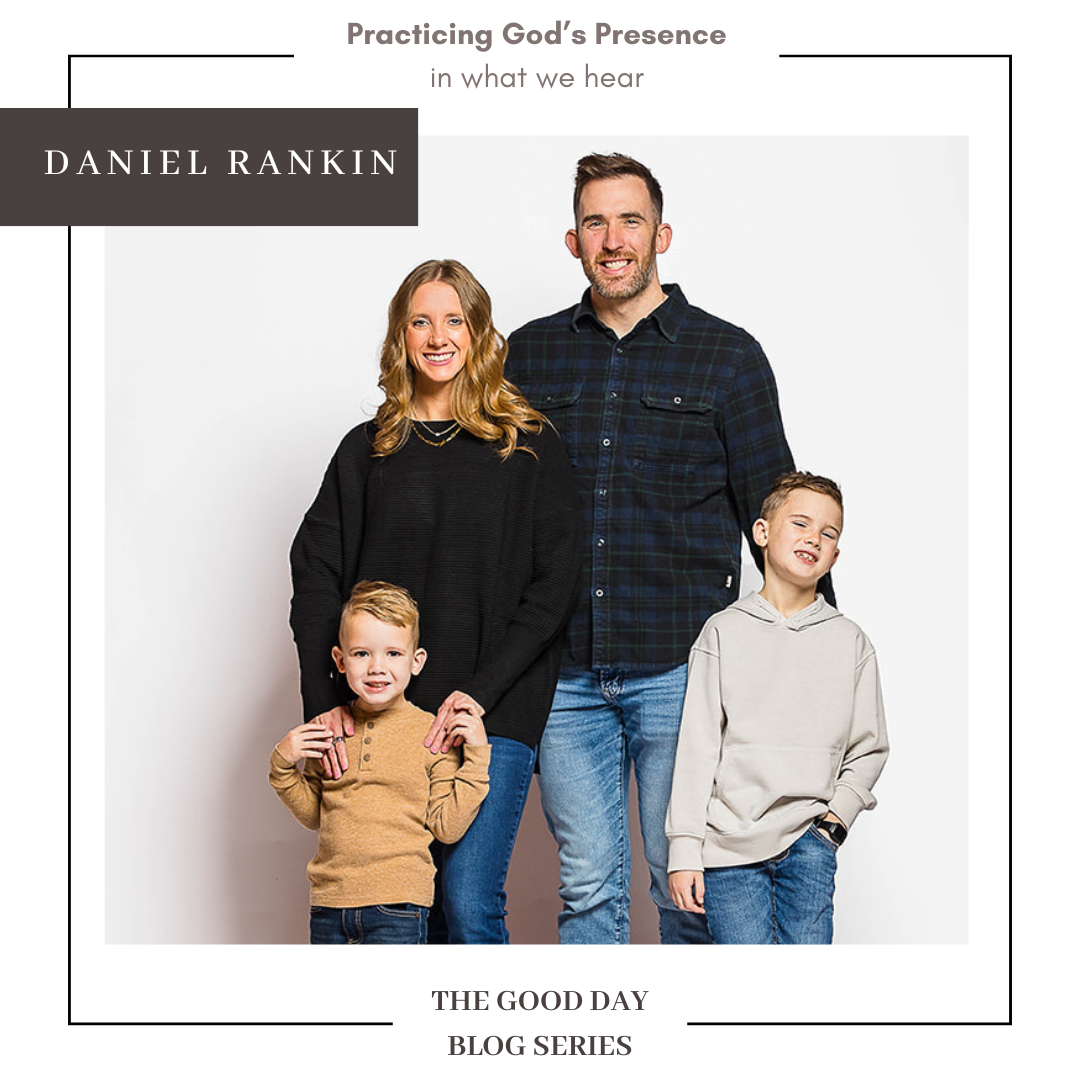
We're talking about practicing the presence of God in what we hear on the podcast right now, and I'm honored to introduce you to a pastor of mine, Daniel Rankin, as he shares a reflection from 1 Samuel. I hope you'll join us in practicing these seven words on a daily basis and resist the urge to rush or hurry through, but intentionally pause and open your heart and your mind, indeed your whole being, to really listen. (And if you pray for God to help you in this practice, don't be surprised if the Holy Spirit starts waking you up early ...at least that's been my experience this week. Simply take it as an invitation to practice God's presence when all the other needs are still.)
Daniel Rankin is the Pastor of Student Ministries at Crossings Community Church, and lives in Edmond, OK with his wife and 2 sons. He and his wife grew up in northeast Arkansas and are lifelong Razorback fans (woo pig!). Daniel has spent the last 15 years serving as a student pastor, and is passionate about helping students find and follow Jesus! In his free time you can find him coaching his sons' baseball and basketball teams, eating good food, and enjoying time outdoors hunting & fishing.

If you stepped into any grocery store this past weekend, you saw it: the frantic rush for bread, milk, and eggs. Whenever a "Snowmageddon" is forecasted, the world gets loud. I was watching a local meteorologist recently who was so demonstrative and excited he was practically shouting at the camera. His parting words? "Stay tuned for more updates."
Stay tuned. That seems to be the mantra of our modern world. We are constantly told to stay tuned to the loud voices, the influencers, the breaking news, and the streamers. In the "Land of the Loud," attention is currency. But in the middle of all that noise, it can be tempting to think that God has gone silent.
Is God silent? And if not, how do we actually hear His voice?
When the Word is Rare
In 1 Samuel 3, we find a world that looks a lot like ours. The scripture says:
"In those days the word of the Lord was rare; there were not many visions." -1 Samuel 3:1
For a people used to parting seas and pillars of fire, this must have felt like a spiritual drought. But if you look at the leadership of that time—specifically Eli’s sons—you see that they "had no regard for the Lord."
Here is the hard truth: When our hearts turn away, our ears usually turn off. Often, we feel God is silent, but the reality is that we are simply tuned into the wrong frequency. We are cluttered by noise, busyness, or spiritual apathy. What if we viewed God's silence not as an absence, but as an invitation to seek Him more deeply?
The Learning Curve of Listening
In the passage, young Samuel hears a voice calling his name. He assumes it’s Eli, his mentor. He runs to him three times before they realize it isn’t a man speaking—it’s God.
I love this because it shows that God is patient with our learning curve. It’s okay to be confused at first. It can be hard to discern if a thought is from God, your own head, or something you heard on a podcast.
Notice that God didn’t stop calling just because Samuel didn't recognize Him at first. He kept calling until Samuel was ready to listen.
Tuning the Dial to Humility
Finally, Eli gives Samuel the "frequency" for hearing God. He tells him to say:
"Speak, Lord, for your servant is listening." (1 Samuel 3:9)
Notice the order. It isn’t "Listen, Lord, for your servant is speaking." That’s entitlement. Humility is the "on switch" for spiritual hearing. When our hearts are surrendered to His will before He even speaks, the static begins to clear.
Does this mean you’ll hear an audible voice telling you exactly which socks to wear? Probably not. But when you position yourself in humility, His Word comes alive. A conversation with a friend suddenly carries a weight of truth you hadn't noticed before. It’s not about how He speaks, but about us being available to listen.
3 Ways to "Tune In" This Week
If you’re tired of the static and want to hear the Shepherd’s voice, try these three shifts:
Hang Out Where He Hangs Out: You can’t hear someone if you aren't in the same room. Spend time in His Word, in prayer, and in community.
Make it a Team Sport: Don’t try to discern God’s will in a vacuum. Talk to a mentor, a pastor, or a friend. God often uses human voices to help us recognize His divine one.
Surrender the Answer First: Ask yourself, "Have I already said 'no' to the last thing He told me to do?" Tuning in starts with a heart that is already surrendered to the answer, even before the question is asked.
Your Challenge: This week, don't ask God for a sign. Just give Him your "settings." Every morning, before you check your phone or look at the weather report, say these seven words:
"Speak, Lord, for your servant is listening."
Then, give Him just 60 seconds of silence. You might be surprised by what you hear when the world finally goes quiet.

Our strength grows not as we become more independent but as we grow dependent on God, strengthened as we come to Him daily and throughout our day in prayer, remembering prayer is not one way but two-way - talking and listening. Our joy grows as we become close to God and enjoy conversation and friendship with Him. Our peace grows as tune in to what the Holy Spirit is revealing to us and we learn to rest in the wonder-filled presence of God, which has been made available to us through Christ His Son.
The good life, well it starts with a good day. Then another. Then another. Let's choose to live #TheGoodDay one day at a time.


Comments